


Key takeaways
- Jira knows how much work is in a sprint but not how many hours each person actually has, which is the gap capacity planning apps fill.
- Jira Plans, included in Jira Premium and Enterprise, plans capacity per team per sprint or iteration; it doesn't track individual days, vacations or public holidays.
- The main difference between the apps is the unit they plan in: a person per day (ActivityTimeline, TeamBoard TimePlanner), full-time equivalents (Tempo Capacity Planner), or a portfolio of programs (BigPicture).
- If you also need logged time compared with planned time, check whether the planner reads Jira work logs or needs a second app.
- ActivityTimeline plans per person per day with time off and Jira work logs on one timeline. You can try it free for 30 days.
Every capacity problem in Jira looks the same from the outside: a sprint that was fine on Monday is overcommitted by Wednesday, because two people were on leave and one was pulled into support. Jira had all the issues. It just didn't know who was actually there.
That's what a capacity planner adds. Below are five options, starting with the one you may already pay for, compared on the things that decide whether a plan survives contact with real people: how capacity is measured, whether time off counts, and whether you can check the plan against the hours people log.
What should a Jira capacity planner do?
A capacity planner answers "who has time for this, and when?" To do that well it needs four things: availability per person (working hours, part-time, time off, public holidays), the work already on each person's plate (Jira issues with estimates), a view across projects (people rarely work on one), and a way to compare plan with reality (logged time). The five tools below differ mostly in which of these they treat as the core.
5 capacity planning apps for Jira compared
Prices change often and depend on user tiers, so check each Marketplace listing on the day you compare.
1. ActivityTimeline
Best for: teams that plan per person per day and want time off and logged time in the same place.
ActivityTimeline puts every person on a row, their Jira issues on the days they're scheduled, and their vacations, sick days, holidays and bookings on the same row. A workload indicator under each person compares scheduled work with their hours for that day: green when it fits, yellow or olive when there's room, red when they're overloaded. You plan by dragging issues from a backlog onto someone's row; split one issue across several days or people; or drop a placeholder to reserve time before the Jira issue exists. Reports include a Team Capacity chart and a Resource Utilization Forecast for the months ahead, and Planned vs Actual compares estimates with Jira work logs.
Honest limits: it only works with Jira, splitting issues doesn't work with story-point estimation, and there's no desktop timer app.
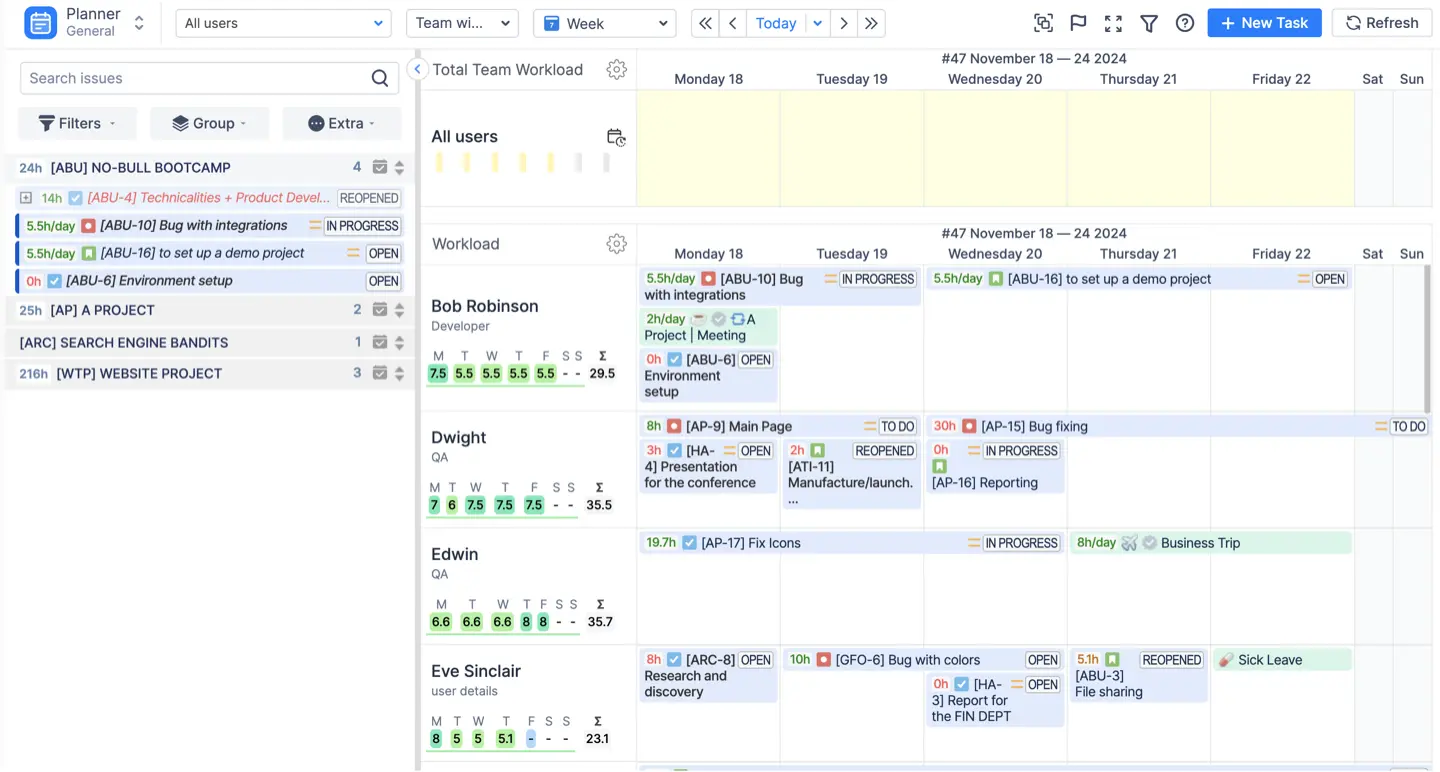
2. Tempo Capacity Planner
Best for: organizations already using Tempo Timesheets that plan in full-time equivalents.
Formerly Tempo Planner. You schedule individuals and teams at project, task or ticket level, plan in FTEs, configure holidays and workloads, show Google and Office 365 calendar events, and request time from other teams. Comparing estimated with actual time uses Tempo Timesheets, which is a separate app and a separate licence. On the Marketplace it has 3.7 out of 5 from about 200 ratings and around 9,400 installs.
3. Jira Plans
Best for: Jira Premium or Enterprise customers who plan at team and sprint level.
Jira Plans (formerly Advanced Roadmaps) pulls issues from several projects into one plan, lets you set capacity per team per sprint or iteration, and shows when a sprint is over capacity. It's included in your Jira plan, which makes it the obvious starting point. What it doesn't do is plan individual people day by day: there's no place for Anna's two days off, and no comparison with logged time.
4. BigPicture
Best for: PMOs running portfolios of programs with Gantt charts, risks and dependencies.
BigPicture is a project portfolio suite: Gantt, roadmaps, risks, and a resources module that shows capacity and allocation by team and person. It's the most complete for portfolio management and the heaviest to set up; capacity is one module among many. Time tracking comes from a separate app.
5. TeamBoard TimePlanner
Best for: smaller teams that want a calendar-style planner with built-in timesheets.
TimePlanner by TeamBoard (DevSamurai) combines resource scheduling on a calendar, leave and holiday management, timesheets and cost tracking. It covers per-person capacity and logged time in one app.
Which capacity planner should you choose?
Start from the unit you plan in. If you plan sprints by team and you're on Premium, try Jira Plans first, because you already have it. If you plan people by day and time off keeps breaking your plans, you need a per-person planner: ActivityTimeline or TimePlanner. If you're a Tempo shop measuring FTEs, Tempo Capacity Planner fits next to Tempo Timesheets. If what you manage is a portfolio, not a team, look at BigPicture.
Our view, since this is our list: for most teams under a few hundred people the question that hurts is "who is actually free next week?", and that needs days, people and time off on one screen. That's what we built ActivityTimeline for, and it's also why it isn't the right tool for portfolio-level risk management.
For a closer look at Tempo's alternatives, see Tempo Planner alternatives.
FAQ
Does Jira have capacity planning?
Partly. Jira Plans, included in Jira Premium and Enterprise, lets you set team capacity per sprint or iteration across projects. It doesn't plan individual people by day or account for vacations and holidays, which is what capacity planning apps add.
What is the best capacity planning plugin for Jira?
It depends on the unit you plan in. For people by day with time off, ActivityTimeline or TeamBoard TimePlanner; for FTE planning alongside Tempo Timesheets, Tempo Capacity Planner; for portfolios, BigPicture.
Can Jira show who is overloaded?
Not per person per day. Jira Plans can show a team sprint over capacity. Per-person workload, with time off taken into account, needs an app such as ActivityTimeline, which marks overloaded days in red.
Do capacity planners work with story points?
Most do, if story points are converted to hours. In ActivityTimeline you can set a conversion factor; splitting one issue across people works only with time estimates.
If time off keeps breaking your sprint plans, try ActivityTimeline on your own Jira for 30 days. Start the trial


