


Key takeaways
- A Jira issue can have only one assignee, in Cloud and Data Center, and that won't change with a setting.
- The usual workarounds are sub-tasks (one per person), a multi-user picker custom field, or watchers; each one shows more people, none of them gives each person their own share of the work.
- Anyone with permission can log work on an issue, assigned or not, so time tracking doesn't need everyone to be the assignee.
- If several people really share one issue, the problem is planning: who works on it on which days, for how many hours.
- ActivityTimeline splits one Jira issue into parts for different people, each with its own dates and estimate. You can try it free for 30 days.
A designer and a developer are pairing on the checkout page. A QA engineer and a support engineer are both chasing the same production bug. In Jira, only one of them can be the assignee, and the other one disappears from every filter, board and workload view that matters.
Here's the short answer: Jira doesn't support multiple assignees, and there's no hidden setting for it. What you can do is show the extra people somewhere else on the issue, or split the work so each person has their own part. Below are four ways, from the simplest to the one that actually plans the work.
Can a Jira issue have more than one assignee?
No. The Assignee field in Jira holds one person, in Jira Cloud and Data Center, and Atlassian has kept it that way on purpose: one owner per issue. If two people really own the work, Jira expects two issues.
4 ways to assign a Jira issue to several people
1. Create a sub-task for each person
The native way. Create one sub-task per person under the shared issue, assign each sub-task, and give each its own estimate. Everyone sees their own piece on their board, and the parent shows the total.
The cost is clutter: a two-person issue becomes three issues, and a team that does this for every pairing doubles its issue count.
2. Add a multi-user picker field
A custom field that holds several people, often named Collaborators or Co-assignees.
- As a Jira admin, go to Settings → Work items → Fields and click Create new field.
- Choose User Picker (multiple users), name it, for example Collaborators.
- Add it to the screens your projects use.
- On the issue, add the extra people to the new field.
- To find everything someone shares, search Collaborators = currentUser() OR assignee = currentUser().
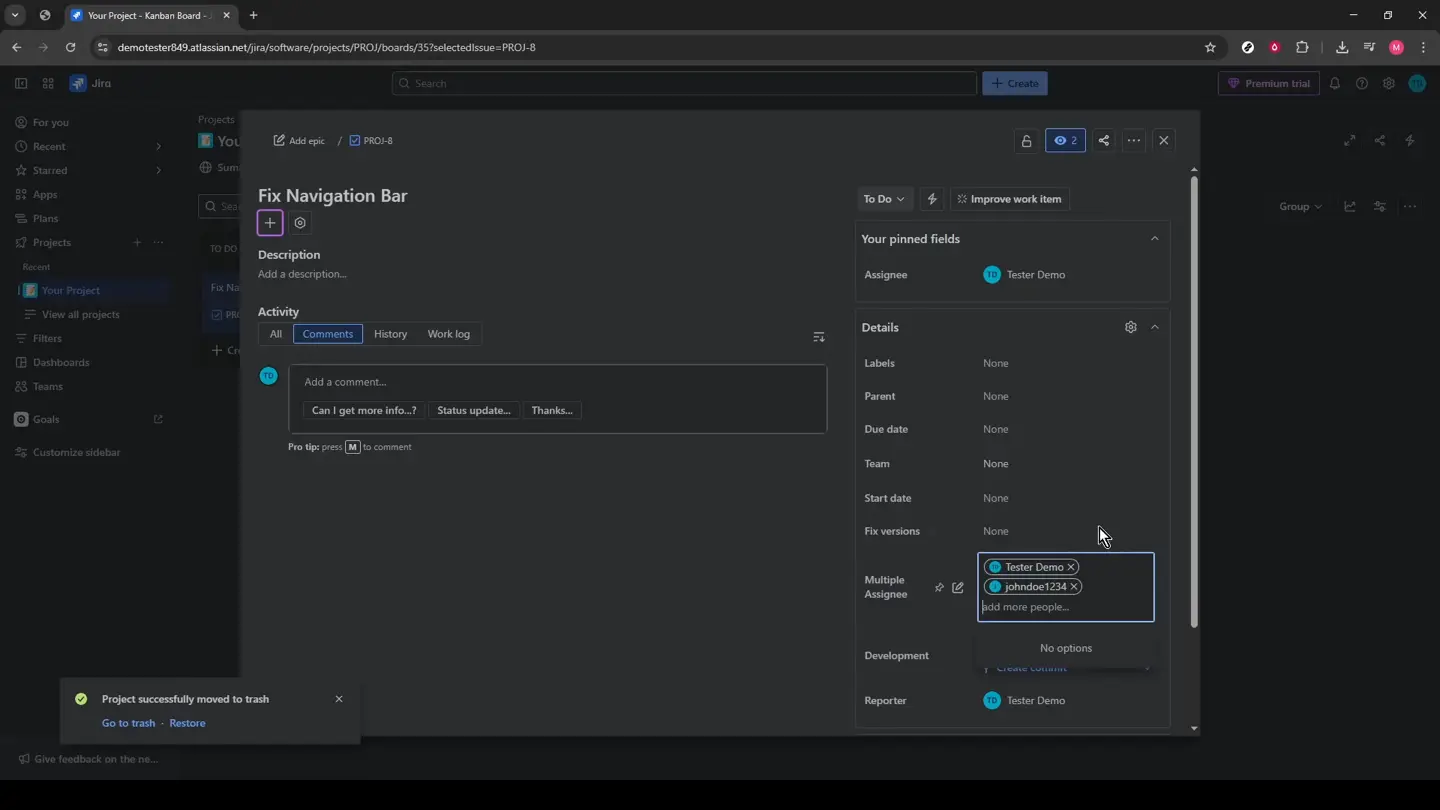
The limit: Jira treats this field as information, not ownership. Boards, the assignee filter and Jira's own workload views still see only the assignee.
3. Use watchers
Add the other people as watchers. They get notifications and the issue appears in watcher = currentUser(). It's the lightest option and the least visible: nothing on a board says they're involved.
4. Split the issue between people in ActivityTimeline
If two people really share the work, the question isn't who's named on the issue. It's who works on it, on which days, for how many hours. ActivityTimeline answers that by splitting one Jira issue into parts:
- Drag the issue onto someone's timeline while holding Shift, or click it and choose Split → Create New Issue Part. Each part gets its own person, dates and estimate.
- The parts stay one Jira issue. The remaining estimate is shared between them, and you can set different hours per person in Manage Issue Parts.
- To drive it from Jira instead, map your multi-user picker field under Configuration → Jira Integration → Issue Collaborators. Naming people in that field then splits the issue across their timelines, and changes sync both ways.
- Each person's part counts towards their workload, so you see when a shared issue overloads someone.
Honest limits: splitting doesn't work if your team estimates in story points, and the multi-user picker integration doesn't work with team-managed projects. Full details: how to split one Jira task between several assignees.
Can several people log time on one Jira issue?
Yes. Anyone with permission to work on an issue can log time on it, whether they're the assignee or not. Each work log records who logged it, so a report grouped by person shows each contributor's hours on the shared issue.
Which method should you use?
For a one-off pairing, add a watcher or a Collaborators field and move on. For work that really has separate pieces, use sub-tasks. For shared work you need to plan, so each person has their own dates and hours without cluttering Jira with extra issues, split it on a timeline.
FAQ
Can you assign a Jira issue to two people?
No. A Jira issue has one assignee. To involve more people, create a sub-task for each, add a multi-user picker field such as Collaborators, add watchers, or split the issue between people with an app such as ActivityTimeline.
How do I add a second assignee field in Jira?
A Jira admin creates a custom field of type User Picker (multiple users), for example Collaborators, and adds it to the project's screens. It shows extra people on the issue, but boards and assignee filters still only use the main assignee.
Can two people log time on the same Jira issue?
Yes. Logging work doesn't require being the assignee. Each work log keeps the person's name, so reports can show each person's hours on the shared issue.
How do I split one Jira issue between two people?
In Jira, create two sub-tasks. In ActivityTimeline, split the issue into parts for different people with their own dates and estimates; the parts stay one Jira issue.
If shared work keeps disappearing from your team's plan, try ActivityTimeline on your own Jira for 30 days. Start the trial


