


Key takeaways
- Jira records time spent on every issue, but it has no built-in report that shows hours per person per week or month.
- The quickest native option is an issue search with a Time spent column, exported to CSV; it shows each issue's total, not who logged it or when.
- Jira's Time tracking report compares estimates with time spent for one release, which helps with estimate accuracy, not with timesheets.
- To see who logged what, in which period, you need worklog-level data: a script against the Jira API or a Marketplace timesheet app.
- ActivityTimeline timesheets show logged hours by person, project, epic or issue for any date range and export to Excel. You can try it free for 30 days.
It's the end of the month and someone asks a simple question: how many hours did the team spend on Project Atlas in September, and who spent them? Jira has every one of those hours. Getting them out in that shape is the hard part.
Here's the short answer. Jira can tell you how much time was spent on each issue. It can't, on its own, give you a report of time spent by person for a date range. Below are the three ways people get a time spent report out of Jira, what each one really shows, and when it's worth adding an app.
What does Jira's time spent data include?
Every time someone logs work on an issue (the Log work action, or the clock icon in the Time tracking field), Jira stores a work log: who, when, how long, and an optional comment. Jira then adds the work logs up into the issue's Time spent field and compares it with the Original estimate and Remaining estimate.
That's the important detail: the work logs carry the person and the date, but the Time spent field on the issue is just a running total. Most native reports read the total, which is why they can't answer "who, and when".
Time tracking has to be enabled by a Jira admin for any of this to appear. If you don't see Log work on your issues, our guide to time tracking in Jira has the setup.
How do you get a time spent report in Jira? 3 native ways
1. Issue search with a Time spent column
- Go to Filters → Search work items (the issue search).
- Switch to JQL and narrow it down, for example project = ATLAS AND worklogDate >= "2026-09-01" AND worklogDate <= "2026-09-30".
- Open the column picker and add Time spent and Σ Time spent (the second one includes sub-tasks).
- Use Export → CSV to take it to a spreadsheet.
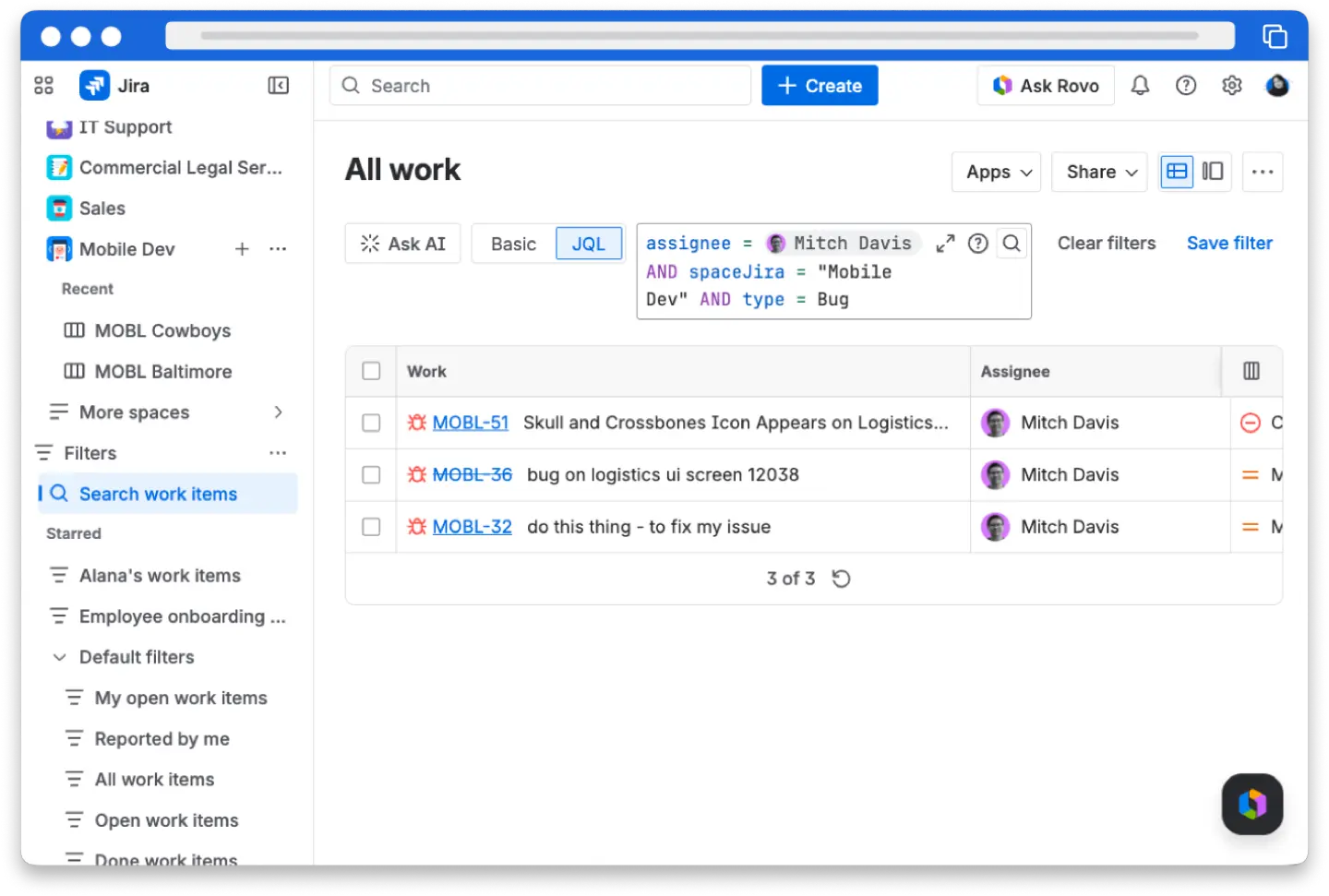
The catch: worklogDate decides which issues appear, but the Time spent column still shows everything ever logged on each issue, by everyone, in any month. Filtering by worklogAuthor = "Anna Kowalska" works the same way. So this gives you "issues someone worked on in September", not "hours logged in September".
2. The Time tracking report
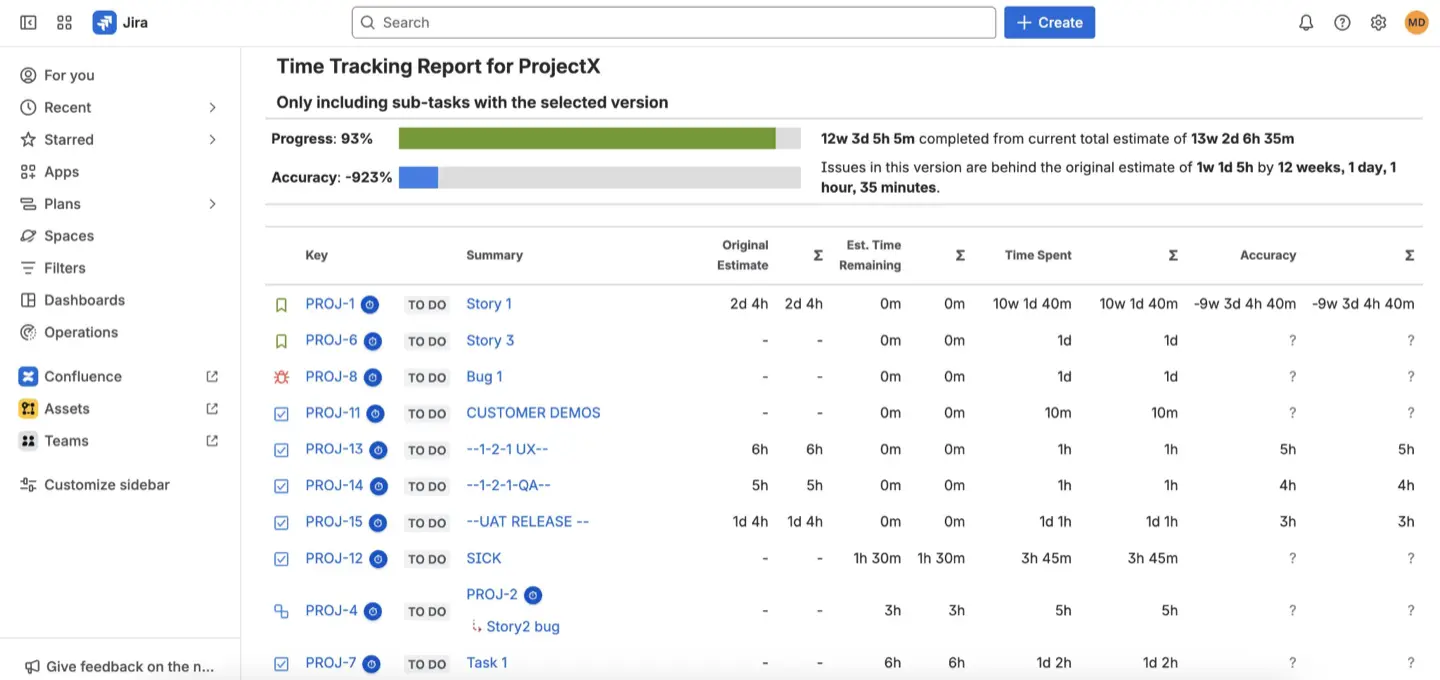
In company-managed software projects, Reports → Time tracking report lists every issue in one release (Fix version) with its original estimate, time spent and remaining estimate, plus two bars showing whether the release is ahead of or behind its original estimate.
It's useful for one thing: checking estimate accuracy for a release. It has no people, no dates, and nothing outside that release.
3. The Jira REST API
The work log endpoint returns each work log with author, start date and duration, so a short script can produce exactly the report you want. It's the only native route to real per-person, per-period numbers, and the cost is that somebody has to write and maintain it.
How do you see time spent by person and by week?
This is where most teams stop fighting Jira and add an app, because the question needs work logs, not issue totals. In ActivityTimeline the report lives in the Timesheets module, and it reads the same Jira work logs, so nobody logs anything twice.
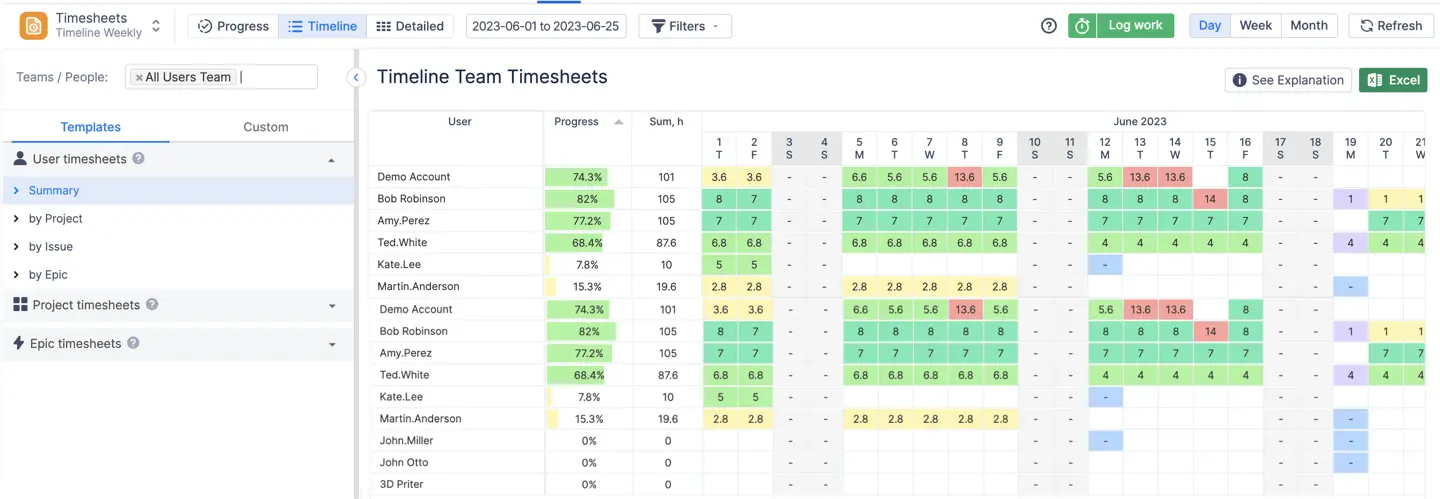
There are three views of the same hours. Progress shows each person's logged hours against their required hours for the period, the "who hasn't filled in their time" view. Timeline shows hours per person per day, week or month, and you can group them by project, epic, issue or any Jira custom field. Detailed lists every work log as a row with user, project, issue, date, hours and comment, and you can add Jira fields as columns.
You choose the scope (teams or people, projects, epics, issues, or a Jira filter) and the period, and export any view to Excel. Save the configuration and next month's report is one click.
To be honest, if you need this once a quarter, the CSV export plus a pivot table is fine. If someone needs it every week, the twenty minutes add up fast.
Which time spent report should you use?
For estimate accuracy on a release, use Jira's Time tracking report. For a one-off list of issues and their totals, use issue search and CSV. For hours by person and period, which is what payroll, client billing and capacity reviews actually need, use a timesheet app or the API. And if you also want to compare logged time with planned time, ActivityTimeline's Planned vs Actual report puts estimates and logged hours side by side per person.
FAQ
Does Jira have a time spent report?
Not by person or date range. Jira shows time spent on each issue and has a Time tracking report that compares estimates with time spent for one release. To see hours per person per week or month, you need a script against the Jira API or a timesheet app.
How do I see how many hours someone logged in Jira last month?
In Jira alone, search with worklogAuthor and worklogDate, then check each issue's work log tab, because the Time spent column shows issue totals. A timesheet app such as ActivityTimeline shows that person's hours for the month directly.
Where is the time tracking report in Jira?
In a company-managed software project, open Reports and choose Time tracking report, then pick a release. It needs time tracking enabled and issues with a Fix version.
Can I export Jira time spent to Excel?
Yes. Export an issue search to CSV with the Time spent column, or export a timesheet from an app. ActivityTimeline exports every timesheet view to Excel with the same grouping you see on screen.
If your month-end report is a CSV and a pivot table, try ActivityTimeline on your own Jira for a month; your existing work logs are already there. Start the 30-day trial


